AI makes me fearful or hopeful?

My essay is based on the thoughts I had after reading the essay "Collaborating With ChatGPT: Considering the Implications of Generative Artificial Intelligence for Journalism and Media Education" (Pavlik, 2023). Pavlik employed ChatGPT to generate content about this new technology to provide readers with the capabilities and limitations of artificial intelligence (AI) in the context of ChatGPT's arrival. Given this context, the author offers fundamental ideas about the educational applications of journalism and media. For my part, I am curious whether the media portraying AI in the context of ChatGPT's appearance has an impact on the audience's emotions.
Since the 1970s, when the first model of human replicating machines was programmed to simulate human conversation, people have been trying to create an entity that can replicate their intelligence. These days, those systems evolved with chatbots and eventually came to be one. They differ in form depending on whether they are designed to help people, simply carry on a conversation, or based on how they interact with people—voice or text, with text being the most common—and take on different forms (Huang et al., 2023). A basic example of an artificial intelligence (AI) chatbot is Siri, which can perform tasks more quickly and provide users with basic information. With access to a large number of apps and capabilities, Siri can answer questions via text or audio (Lee et al., 2020).
Recently, ChatGPT, a new type of chatbot, has gained a lot of popularity across all media platforms (Bartholomew & Mehta, 2023). Within two months after its launch, ChatGPT had over 100 million users, making it the fastest-growing consumer app during that time, and OpenAI's valuation increased to $29 billion (Metz, 2023). Journalists must report on developments with the proper nuance and context for audiences who may be unfamiliar with this type of technology because AI tools are being developed rapidly. However, the media coverage of ChatGPT has been overly dramatic, exaggerating its impact with numerous hyperbolic headlines and content. Noam Chomsky (2023, as cited in Bartholomew & Mehta, 2023) denounced "hyperbolic headlines" in a New York Times opinion piece. And the number of them is high. Here are some typical headlines that cover the AI in the context of ChatGPT’s arrival. “Bing’s A.I. Chat: ‘I Want to Be Alive,” “‘Godfather of AI’ says AI could kill humans and there might be no way to stop it,” “Could ChatGPT write my book—and feed my kids?” “Meet ChatGPT, the scarily intelligent robot who can do your job better than you,” “Microsoft’s new ChatGPT AI starts sending ‘unhinged’ messages to people,’’ “What is AI chatbot phenomenon ChatGPT and could it replace humans?” (Bartholomew & Mehta, 2023).

Screenshot of one article in a hype way of the headline. Source: CNN
This framing raises concerns because it leaves the public out of crucial conversations about ethics, usage, and the future of work while giving the science-fiction version of the AI story (Burrell, 2023, as cited in Bartholomew & Mehta, 2023). Some people find it frightening to think that artificial intelligence will one day surpass human capabilities, but many people now believe that this will happen sooner rather than later (Kim, 2019). Throughout human history, this is called a fear of new technology and irrational. Brosnan (2002) stated that there has always been a generalized fear of useful technology. According to him, technophobia is a negative emotional and attitudinal reaction to technology rather than a fear of losing one's job or being concerned about the effects of screen radiation.
The highly debated theory that super intelligent AI could end humankind is currently being used by many in the AI community to warn about the "existential risk" posed by AI systems. Should they choose to address the populace, they will discover that a significant portion of them—38 percent of a sample size of 2000 people—agree that artificial intelligence will ultimately destroy human civilization. Maybe this explains why there are more worried people than not (Kastrenakes & Vincent, 2023). Thus, it is possible that people's fear of AI stems from their natural anxiety about the future that has not yet arrived but based on how media coverage this topic in a hype way.
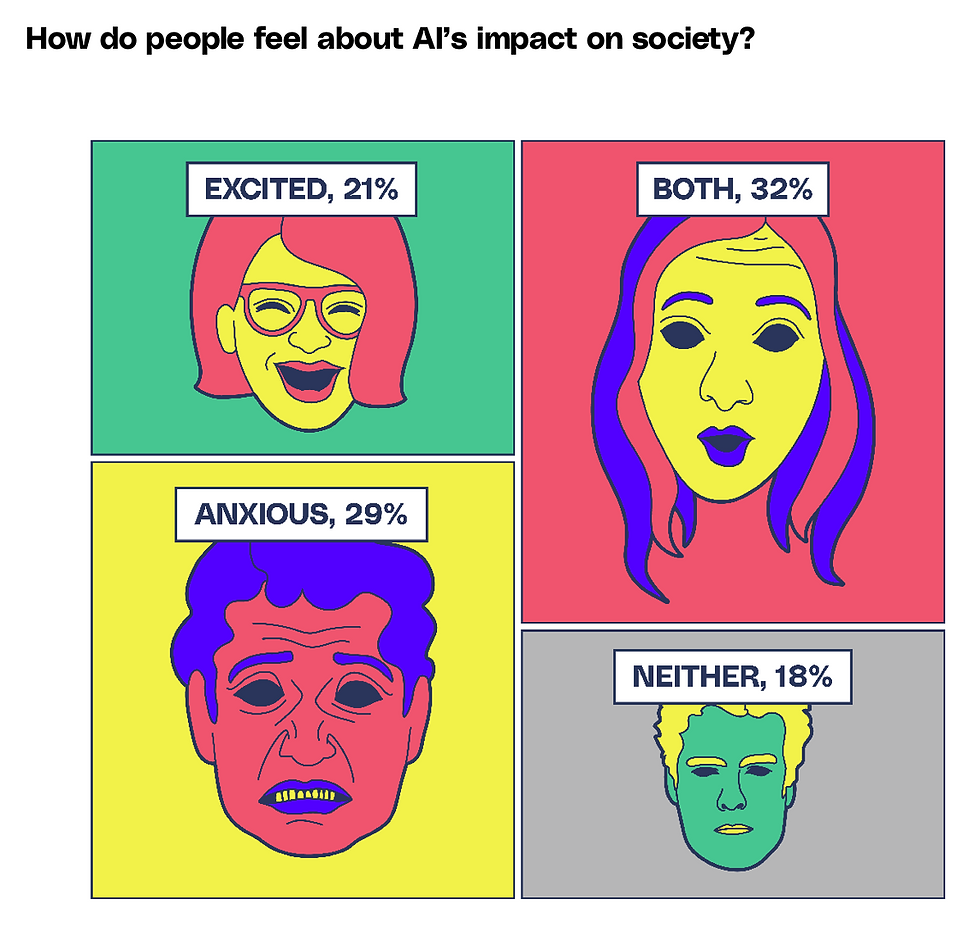
The emotional reaction of the audience when they were asked about AI (Sample size: 2000 US adult). Source: www.theverge.com
If so, I'm eager to conduct research that aims to discover how media coverage portrays AI in the context of ChatGPT’s arrival and the message about AI fear, whether it affects people’s emotional reaction, their attitude and trust in AI, and their intentional behavior using AI. This research will be divided into two studies. Study one will focus on the media coverage of chatGPT with a focus on how the media portrayed AI in a hype way. Study two will focus on the impact of users' attitudes and trust in AI as well as their intentional behavior using AI.
References
Bartholomew, & Mehta. (2023, March 26). How The Media Is Covering ChatGPT. Columbia Journalism Review. Retrieved December 2, 2023, from https://www.cjr.org/tow_center/media-coverage-chatgpt.php
Brosnan, M. J. (2002). Technophobia: The Psychological Impact of Information Technology. Ukraine: Taylor & Francis.
Huang, D., Harasim, S.-A., & Leccia, F. (2023). Understanding the emotional experience on consumer behaviors : A study on ChatGPT service [Student thesis, DiVA. http://urn.kb.se/resolve?urn=urn:nbn:se:hj:diva-60634
Kastrenakes, J., & Vincent, J. (2023, June 26). Hope, Fear, and AI. The Verge. Retrieved January 23, 2024, from https://www.theverge.com/c/23753704/ai-chatgpt-data-survey-research
Kim, J. (2019). Fear of artificial intelligence on people’s attitudinal & behavioral attributes: An exploratory analysis of AI Phobia. GSJ, 7(10).
Lee, J. H., Yang, H., Shin, D., & Kim, H. (2020). Chatbots. ELT Journal, 74(3), 338-344. https://doi.org/10.1093/elt/ccaa035
Metz. (2023, October 20). OpenAI in Talks for Deal That Would Value Company at $80 Billion. The New York Times. Retrieved January 9, 2024, from https://www.nytimes.com/2023/10/20/technology/openai-artifical-intelligence-value.html#:~:text=A%20month%20later%2C%20the%20venture,company%20at%20around%20%2429%20billion.
Pavlik, J. V. (2023). Collaborating With ChatGPT: Considering the Implications of Generative Artificial Intelligence for Journalism and Media Education. Journalism & Mass Communication Educator, 78(1), 84-93. DOI: 10.1177/10776958221149577



Comments